
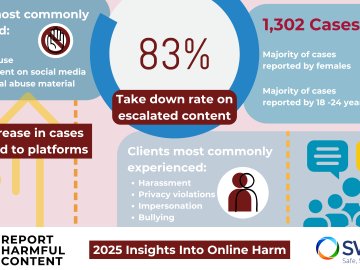
Report Harmful Content (RHC) handled 1,302 cases of reported online harm in 2025. Harassment was the most reported category, accounting for 13% of cases, an increase of 5% compared to 2024. Privacy violations made up 11% of cases and also increased year-on-year. These included image misuse, sharing of personal information, and boundary-crossing online behaviour.
Bullying accounted for 9% of cases, a slight decrease. Adult content on social media also represented 9% of cases, although overall reports of adult content increased by 6%.
Demographics
- 44% of clients were female, 41% male, and 15% identified as other or preferred not to say.
- People aged 18–24 accounted for 27% of cases. Within this group, men were more likely to report adult content, sextortion, and bestiality-related content, while women more frequently reported harassment, privacy violations, and intimate image abuse.
- Those aged 25–34 made up 24% of cases, with harassment and privacy violations common across genders. Individuals aged 13–17 accounted for 17% of cases and were more likely to report bullying, privacy breaches, impersonation, and exposure to child sexual abuse material (CSAM).
Nature of Reports
- 45% of cases involved witnessing harm rather than direct experience. This included exposure to animal abuse, adult content on social media, and CSAM.
- 42% of clients reported harm they experienced directly, such as harassment, impersonation, bullying, and privacy violations.
- 20% reported content on behalf of someone else, including parents, carers, professionals, and peers. These categories are not mutually exclusive.
Escalation and Outcomes
- 20% of cases were escalated to platforms, a 54% increase compared to 2024. The most commonly escalated categories were harassment, bullying, adult content, and animal abuse.
- Not all cases were eligible for escalation. Reasons included clients being outside the UK, harms falling outside RHC’s remit (such as CSAM or sextortion), or platforms being out of scope. In these cases, clients were signposted to other services or supported to report directly.
- Of the cases escalated, 83% of content was removed.
Operational Capacity
The 1,302 cases handled in 2025 represent a 32% decrease compared to 2024. This reduction coincided with a period of reduced operational capacity due to limited funding. The decrease in case numbers reflects reduced capacity rather than a confirmed reduction in online harm.
Summary
- Harassment and privacy violations remain the most common reported harms, particularly among younger adults. A significant proportion of reports involve witnessing harmful content.
- Escalation rates increased, and most escalated content was removed.
- Overall case numbers declined during a period of reduced capacity, while reported harms remained consistent in type and distribution.
- The data indicates continued demand for support and ongoing exposure to harmful online content.
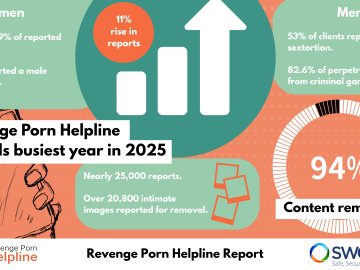
Revenge Porn Helpline Handles Record Number of Cases in 2025
6th July 2026
What Did People Report in 2025? – Insights from Report Harmful Content
5th May 2026

The Rise of Misinformation and Harmful Content During Times of Global Uncertainty
15th April 2026

New Resource: Understanding and Challenging Behaviours Associated with the Manosphere
1st April 2026