Since 1955, the UN Congress on Crime Prevention and Criminal Justice has brought governments, international organisations, civil society and experts together every five years to shape the direction of international policy on crime and justice. The 15th Congress, hosted by the United Arab Emirates in Abu Dhabi, is the largest yet, with more than 5,100 participants.
On its opening day, governments adopted the Abu Dhabi Declaration. It will guide international action for the next five years and highlight the growing criminal exploitation of digital technology. UNODC Executive Director Monica Juma urged delegates to focus on those most exposed to harm, including women facing violence online. She called on governments to accelerate the signing and ratification of the UN Convention against Cybercrime which for action against intimate image abuse is significant. Article 16, a global treaty will for the first time require states to criminalise the non-consensual sharing of intimate images. The Convention is open for signature until the end of 2026 and will enter into force once 40 states have ratified it.
Why This Needs Collective Action
Non-consensual intimate image (NCII) abuse is now among the clearest examples of a harm that no country can address alone.
It crosses borders. An image taken in one country can be hosted in a second and viewed in a third. It is being accelerated by AI, as nudification tools mean intimate images can now be created of anyone without any original image being shared. This harm is being overwhelmingly directed at women. Of the images the Revenge Porn Helpline reported for removal in 2025, 98.9% were of women.
The platforms on which this abuse plays out operate globally, while the laws that govern them are national. Encouragingly, approaches are beginning to converge. The United States (through the Take It Down Act), and the UK have each introduced 48-hour takedown requirements. India's amended IT Rules (in force since February 2026,)require platforms to remove intimate images, including deepfakes, within two hours of a complaint.
Consistency now matters as much as ambition. A victim's protection should not depend on where they live, and platforms need clear and compatible expectations across the markets they serve.
The UK Side Event
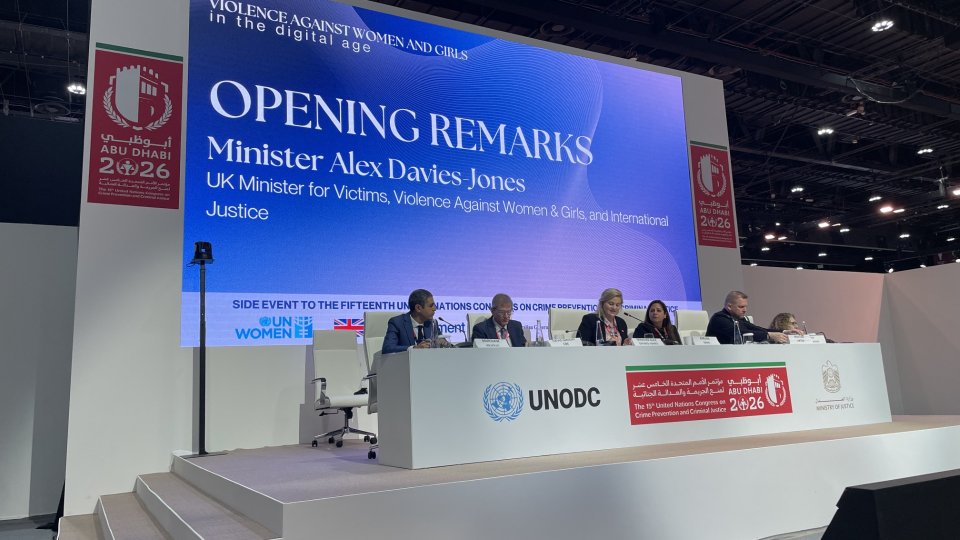
On Sunday 27 September, the UK Ministry of Justice hosted a side event on technology-facilitated violence against women and girls. It focused on the interventions that are working and how international partnerships can strengthen them.
Alex Davies-Jones MP, Minister for Victims, Tackling Violence Against Women and Girls and International Justice, opened and chaired the session. She described a crime where the victim, the perpetrator and the hosting platform can be thousands of miles apart. She argued that international cooperation only works if every country is prepared to act at home.
She set out the steps the UK has taken. It has banned nudification apps and criminalised intimate deepfakes created without consent. It has placed responsibility on platforms to remove content swiftly and is using hash matching so that images which are taken down, stay down. She was equally clear that regulation alone is not enough. Changing attitudes, challenging misogyny and educating men and boys are central to prevention, as set out in the government's strategy on violence against women and girls.
Alex Davies-Jones, Minister for Victims, Tackling Violence Against Women and Girls and International Justice said:
“Cowardly intimate image abuse has a devastating real-life impact on its victims. That’s why in the UK we are delivering a world-leading set of intimate image offences to protect victims and hold vile perpetrators to account.''
''But our work doesn’t stop at regulation. Our VAWG strategy puts the focus on prevention and changing attitudes to stop these crimes from ever happening in the first place. I’d like to thank everyone who came together at the UN Congress on Crime Prevention and Criminal Justice to discuss this vital issue. We’re united across borders in our shared mission to protect women and girls.”
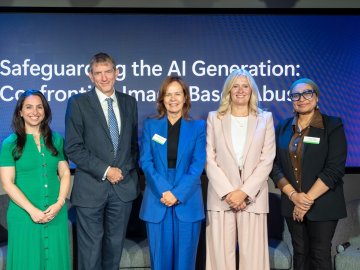
Following a video message from UN Women, the Minister introduced the panel. Karuna Nain is an SWGfL Trustee and former Director of Global Safety Policy at Meta, where she partnered with SWGfL to launch StopNCII.org. David Wright CBE is CEO of SWGfL. Mustafa Erten is Chief of the UNODC Regional Centre for Combating Cybercrime and Head of the UNODC Programme Office in the State of Qatar. Marouane Hejjouji is Head of the Digital Forensics Laboratory within Morocco's Judicial Police Directorate.
Prevention at Source
Karuna began with a simple point. Once content has been uploaded and shared, it is already too late.
She described how technology can intervene at each stage, from creation to upload to amplification. AI models can be trained not only to recognise requests to create intimate images without consent, but to disrupt them and to tell users that such content is harmful and illegal in most jurisdictions.
Platforms can deploy the StopNCII.org hash bank to stop known images being uploaded. They can also use signals such as a change in relationship status to make people aware of StopNCII.org at the moment they may need it.
Karuna also called for clear policies written in language victims recognise. She wanted reporting routes that are easy to use and that connect victims to helplines such as the Revenge Porn Helpline. And she called for cross-platform signal sharing for adult victims, of the kind industry already uses against child sexual abuse.
"The onus right now is on victims to find this content and report it. The more that companies deploy hashing, the more we reduce that burden on them."
She urged companies to work closely with victim advocates, so that the solutions they build can withstand each new technology cycle.
Closing the Gaps
David identified three gaps internationally.
The first is consistency in the law. Article 16 will lead many countries to legislate, and a wave of new laws is already emerging. Making sure those laws protect victims consistently, with consent at their centre, will matter as much as their number.
The second is support for victims. The Revenge Porn Helpline managed around 1,600 cases in 2019; last year it managed nearly 25,000.
SWGfL research estimates that 1.42% of adult women in the UK experience NCII each year. That is around 369,000 women, roughly the entire adult female population of Birmingham. For every woman the Helpline supported last year, there were around 53 more it did not reach.
According to the Helpline's 2025 report, 94% of almost 21,000 images reported for removal were taken down. Yet most countries have no specialist service at all.
The third is the justice response. Only 4% of those the Helpline supported had reported to the police, and three quarters of them described a negative experience. SWGfL is working with the UK's National Centre for VAWG and Public Protection to improve police reporting. That work includes piloting cross-referrals between the Helpline and police, and exploring hashing for evidence, so that images no longer need to be shown routinely in court.
David then turned to the Model National Framework. It was first presented at the UN Commission on the Status of Women in March and is now open for consultation. It was developed by the UK Government, as co-chair of the Global Partnership for Action on Gender-Based Online Harassment and Abuse, together with UN Women, UNODC and SWGfL. It sets out what a national response can look like across policy, law, justice, victim support, industry and research.
No country needs to start from nothing, he said. StopNCII.org allows any adult, anywhere in the world, to create a hash of an intimate image on their own device. That hash is shared immediately with StopNCII.org's 23 partner platforms, and the service is supported by 134 partner NGOs worldwide. The Global Clearing Centre, first built for the Revenge Porn Helpline, now automates reporting for nine NGOs around the world.
"This is a terrible harm, and we deal with its victims all day, every day. But it is preventable. With the right application of technology, it does not need to happen."
Scaling What Works
Mustafa described how UNODC is bringing these elements together in practice. It trains NGOs to receive reports, and trains police and prosecutors to manage digital evidence. It also builds partnerships between public institutions and the private sector.
In the Dominican Republic, UNODC facilitated a national partnership in February 2026. A memorandum of understanding between the National Cybersecurity Commission and StopNCII.org formalised the reporting and takedown of NCII. The country has since amended its law to make NCII an offence.
In Nigeria, UNODC worked with StopNCII.org to expand NGO reporting and train police in digital evidence. It also ran a national awareness campaign with a major mobile operator that reached around 63 million people.
Marouane described Morocco's approach. It combines updated legislation, specialised investigation brigades, digital forensic laboratories and AI-assisted analysis of evidence. A national reporting platform allows victims and witnesses to report anonymously. Morocco has signed both the Budapest Convention and the UN Convention against Cybercrime. No police service can tackle this alone, he said, which makes international cooperation essential.
Policy Shaped by Victims' Experience
Asked how the experience of victims informs policy, David described how cases handled by the Helpline, alongside other campaigners, have informed changes in UK law over many years, through the Ministry of Justice and the Home Office. The 48-hour takedown duty is one example.
Since 30 September, Ofcom's requirements under the Online Safety Act mean platforms are expected to use hashing technology to prevent NCII, the first requirement of its kind.
"We have only got 23 platforms. There should be tens of thousands, and that is what we hope these regulations will translate into."
Closing Remarks
The Minister closed the panel by noting a clear willingness in the room to work together across borders and partnerships. Closing remarks were then provided by Eva Pastrana, Head of the Criminal Law Division and Secretary to the Council of Europe Committee on Crime Problems.
The discussion in Abu Dhabi showed that the building blocks of an effective response already exist. They include laws that put consent at their centre, technology that prevents images being shared, specialist support for victims, and police and prosecutors equipped to act. Countries in Africa, Latin America and elsewhere are already putting them in place.
The opportunity now is to make that response consistent and available everywhere. That means signing and implementing the Convention, with Article 16 put into practice in a way that works for victims. It means using shared frameworks and infrastructure rather than building in isolation, as we argued in Closing the Gaps. And it means continued cooperation between governments, industry, civil society and law enforcement at the highest levels.
The Model National Framework is open for global consultation, and we welcome contributions from governments and organisations worldwide. We are grateful to the Ministry of Justice for convening the panel, to our fellow panellists, and to Eva Pastrana for her closing remarks.
If you are worried about intimate images being shared without your consent, visit StopNCII.org. If you are in the UK, you can contact the Revenge Porn Helpline for support.
Or if you are in another country, support is provided by partner organisations https://stopncii.org/partners/global-network-of-partners/