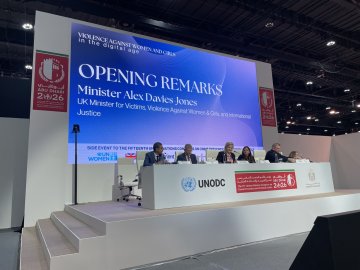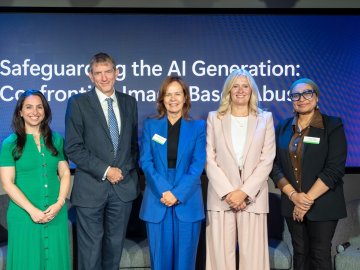
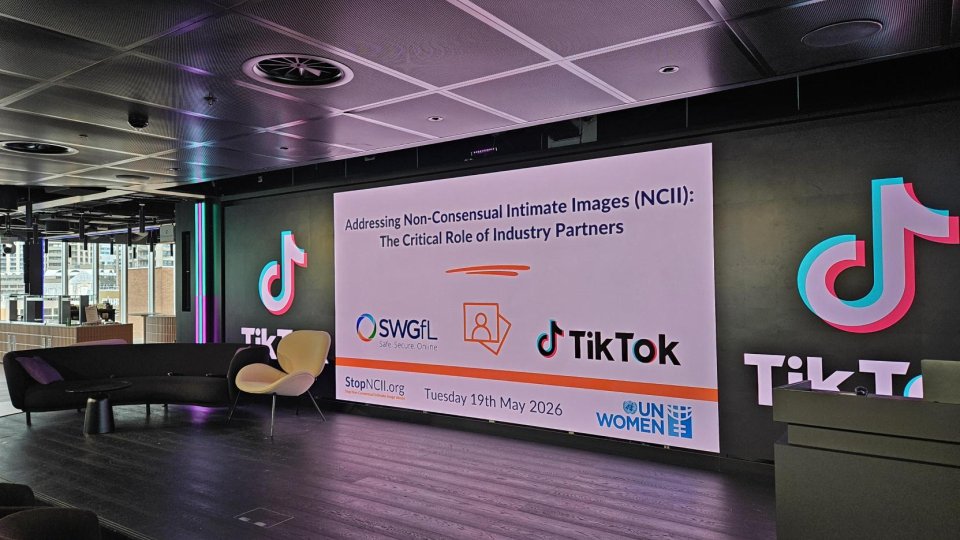
Last week we organised an official side event to the Global Partnerships Conference event which brought together voices from across the online safety sector to explore how collaboration between platforms, regulators and policymakers can drive meaningful progress in preventing and responding to image-based abuse.
Hosted alongside a week of significant progress on technology-facilitated abuse, the event hosted at TikTok’s office in London reflected a growing recognition that NCII is not an issue confined to the margins of the internet but a global challenge that requires coordinated action, shared responsibility and long-term commitment.
The event brought together a diverse range of organisations. Speakers included representatives from SWGfL, TikTok, Ofcom, Meta, UN Women, Revenge Porn Helpline, Cinder, Bluesky, CHAYN, with special introductions delivered by Jodie (a survivor sharing her experiences) and Catherine Atkinson, UK Minister for Victims and Tackling Violence Against Women and Girls Ministry of Justice.
From Reactive to Proactive
Across the discussions, there was a clear sense that the global response to NCII is entering a new phase. Speakers highlighted several landmark developments that signal a move away from fragmented responses towards more systematic protections for victims and survivors.
In the UK, recent legislative changes and recommendations, including the recent takedown obligations, new provisions around perceptual hash matching and enhanced enforcement powers were recognised as major steps forward. At the same time, the implementation of the Take It Down Act in the United States reflects growing international momentum towards rapid removal requirements and stronger platform accountability.
The event also explored the growing role of perceptual hashing technologies and shared hash databases (StopNCII.org), in helping prevent the redistribution of known NCII content across platforms. Participants repeatedly returned to the importance of shifting from reactive moderation to proactive prevention.
Industry Partnership Must Go Beyond Compliance
A central theme throughout the event was the role of industry partners in shaping their environments. While regulation and legislation are becoming increasingly important drivers of change, speakers stressed that platforms must aim higher than simply meeting minimum compliance standards.
There was broad consensus that “safety by design” must become embedded into product development processes from the outset, rather than treated as a reactive policy exercise. Participants discussed how online platforms have both the opportunity and responsibility to build systems that actively reduce opportunities for abuse before harm occurs.
Importantly, conversations also focused on the value of survivor-informed approaches. Across the panel sessions, speakers emphasised that survivors and frontline organisations often identify emerging risks long before institutions or platforms do. Ensuring that lived experience meaningfully informs product development, trust and safety operations and policy decisions was repeatedly highlighted as essential for future progress.
The role of industry funding and long-term investment in specialist support services (like StopNCII.org) was also discussed. Frontline organisations supporting victims of image-based abuse continue to carry significant responsibility, often with limited resources highlighting the importance of sustained support for these services as part of a truly collaborative response.
The Challenge of AI and Emerging Technologies
The second half of the event focused heavily on the evolving threat of generative AI and emerging technologies. Speakers explored how AI-generated intimate imagery, synthetic content and increasingly accessible image-generation tools are accelerating the scale and complexity of abuse. Speakers noted that while technologies such as hash matching remain critical for preventing the redistribution of known content, AI introduces new challenges because entirely new abusive images can now be created instantly and at scale.
At the same time, there was cautious optimism about AI’s potential to strengthen prevention and detection efforts. Industry representatives discussed opportunities to use AI systems to proactively identify harmful content, detect policy violations earlier and support faster response mechanisms across platforms. However, speakers also stressed that technical solutions alone are not enough.
A recurring message throughout the event was that emerging technologies reflect and amplify existing societal inequalities. Without robust safeguards, AI systems risk reproducing misogyny and other forms of abuse at scale.
Collaboration Remains Essential
One of the clearest takeaways from the event was that no single organisation can tackle NCII alone. Government, regulators, platforms, charities, survivor advocates and researchers all have distinct but interconnected roles to play. Discussions repeatedly highlighted the importance of information sharing, coordinated enforcement, common standards and cross-border collaboration, particularly given the inherently global nature of online abuse.
There was recognition that the past year has brought significant advances in policy, regulation and industry engagement around NCII. Yet speakers also acknowledged that technology will continue to evolve rapidly, and that maintaining momentum will require sustained commitment from all stakeholders.
David Wright CEO of SWGfL said: “The timing of the event was no accident coming in such an important week, this event demonstrated just how important collaboration has become in tackling NCII abuse. No single organisation, platform or government can solve this challenge alone. Real progress depends on all stakeholders working together to build systems that prevent harm before it occurs.
We are proud to have partnered with TikTok to bring together so many important voices at such a pivotal moment. The conversations this week reinforced both the urgency of the issue and the opportunities we now have to continue fighting this abuse.’’
Catherine Atkinson UK Minister for Victims and Tackling Violence Against Women and Girls Ministry of Justice said: "I'm proud to represent the UK Government as we collaborate internationally to tackle the rising issue of intimate image abuse. This isn’t a problem confined to a corner of the internet - thousands of women and girls across the world fall victim every day.
"Through our historic Crime and Policing Act, we have introduced crucial new criminal offences to tackle misogynistic content online and are enabling courts to mandate the deletion of such degrading content. But there's further to go, and it's vital that platforms such as TikTok are not only part of but, but leaders of the conversation."
"The reality of violence against women and girls is stark, but speaking at this event and sharing a room with so many experts impassioned to put real protections in place, I felt renewed hope for a safer online world."