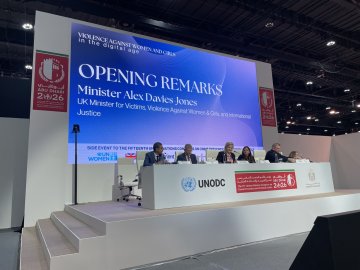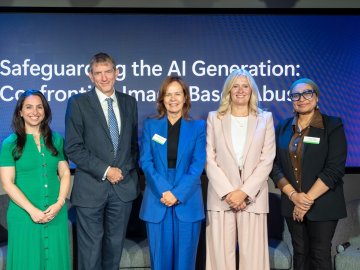

SWGfL presented at the World Summit on the Information Society (WSIS) Forum 2026 this month, hosting an important international discussion on preventing Non-Consensual Intimate Image (NCII) abuse and strengthening global responses towards technology-facilitated gender-based violence.
A Global Conversation on NCII Abuse
The session, "Preventing Non-Consensual Intimate Image Abuse: Global Responses to Tech-Facilitated Gender-Based Violence," brought together policymakers, regulators and industry experts, including SWGFL’s Head of Support Services Sophie Mortimer, to examine how countries, platforms and international organisations can work together to better protect victims and hold perpetrators accountable.
A key focus of the discussion was the growing obligation on countries to criminalise the non-consensual distribution of intimate images under the Cybercrime Convention. Delegates explored the challenges many member states face in adapting existing legislation, particularly where image-based abuse is currently addressed through broader defamation, obscenity or privacy laws rather than dedicated criminal offences.
An Opportunity to Change Legislation
Emily Harman, who represented SWGfL in moderating the panel at the forum, highlighted the significance of criminalising NCII distribution:
"The Cybercrime Convention requirement to explicitly criminalise NCII distribution poses an interesting challenge and opportunity for countries to revisit their image-based abuse and privacy laws. Many member states do not specifically penalise intimate image distribution, instead relying on defamation or obscenity laws - for example banning all distribution of pornography. These are unlikely to be considered sufficient to comply with article 16 and so it's a real opportunity to evolve countries' laws to create better access to justice for victims. We really hope this development of domestic legislation is also used as an opportunity to create harmonization between countries when it comes to reporting pathways."
The discussion highlighted how emerging international standards could help strengthen protections for victims while creating more consistent legal approaches across jurisdictions.
The Need for Cross-Border Cooperation
The conversation also examined the need for harmonised international reporting channels, recognising that NCII abuse frequently crosses borders and can involve victims, perpetrators and platforms operating in different jurisdictions. The European Commission emphasised the importance of member states learning from countries with more mature responses to NCII abuse and working towards greater consistency in approaches.
Participants agreed that improved cooperation between governments, regulators and technology companies will be essential to ensuring victims receive timely support regardless of where abuse occurs.
Raising the Bar for Platform Safety
Representatives from Ofcom shared insights into the UK's regulatory expectations, stressing that safety should be embedded from the very beginning of a platform's product development process. Ofcom also made clear that any platform with a content upload function should consider itself at risk of being used for NCII distribution and should take appropriate preventative measures.
The session highlighted the increasing adoption of domestic legislation that criminalises NCII distribution and requires rapid content removal. Participants discussed the role of platforms in preventing abuse, with particular attention given to proven safety measures such as hash-matching technologies and robust takedown policies.
Model National Framework
During the discussion, Sophie Mortimer presented our Model National Framework for Addressing Non-Consensual Intimate Images, developed in partnership with the United Nations Office on Drugs and Crime (UNODC). The framework provides governments with a practical blueprint for creating coordinated national responses, covering legislation, victim support, platform accountability and public awareness.
The framework was highlighted as an example of how countries can develop comprehensive and effective responses to image-based abuse while ensuring victims remain at the centre of policy development.
The session concluded with a clear call for stronger international collaboration, wider adoption of proven policy frameworks and greater accountability for platforms to implement effective safeguards against NCII abuse. As countries work towards meeting emerging international obligations, we continue to advocate for a victim-centred approach that delivers meaningful protections that can used worldwide.