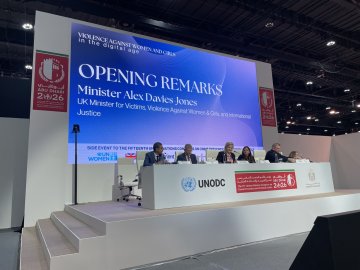
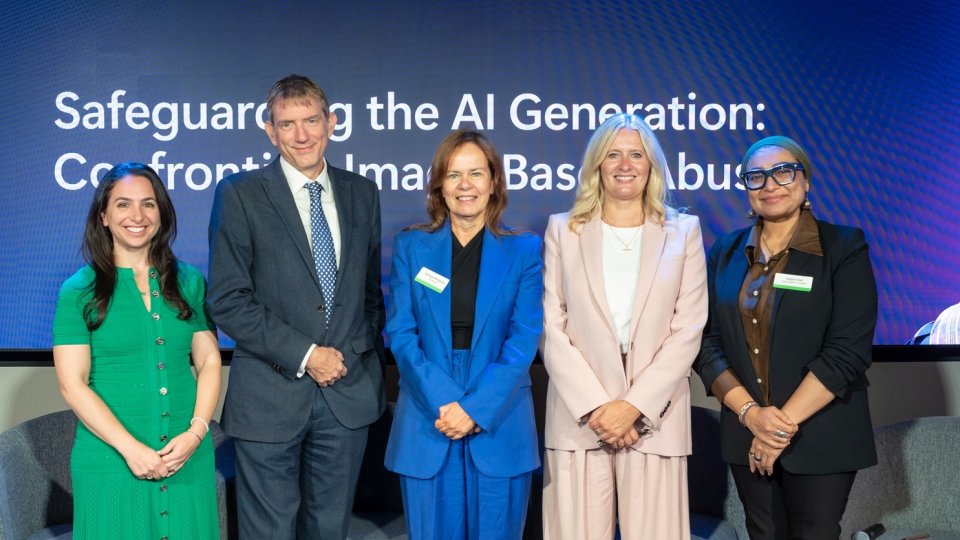
During the UN General Assembly’s High-Level Week in New York earlier this month, SWGfL co-hosted “Safeguarding the AI Generation: Confronting Image-Based Abuse” with Microsoft and the UK Foreign, Commonwealth and Development Office (FCDO).
The event brought together governments, UN agencies, regulators, civil society and industry looking at how the benefits of AI and digital technology can be realised while strengthening protections for those most at risk of harm, including women, children and young people.
It was opened by Jenny Lay-Flurrie, Corporate Vice President at Microsoft, and Baroness Harriet Harman, the UK’s Special Envoy for Women and Girls. Two panel sessions followed, and the event closed with a call to action on the Model National Framework. The UN General Assembly
The high-level week of the 81st session of the UN General Assembly began in New York on 22 September 2026. At the General Debate, the annual meeting of Heads of State and Government at the beginning of the General Assembly session, world leaders make statements outlining their positions and priorities. His Excellency Khalilur Rahman of Bangladesh is presiding over the 81st session, under the theme “Restoring trust, managing transformation: A United Nations that delivers for all.”
It is the one moment each year when every member state is represented at the highest level. Alongside the formal debate, many other high-level thematic meetings, summits and informal events are held during general debate week.
For NCII abuse, it is a harm that crosses borders, with victims, perpetrators, and platforms often in different jurisdictions. Under Article 16 of the UN Cybercrime Convention, countries are now expected to criminalise the non-consensual sharing of intimate images, and many do not yet do so. Bringing the issue to UNGA places it in front of the governments who will shape that response.
The Scale of the Challenge
Opening the first panel, David Wright CBE, CEO of SWGfL, shared the experience of the Revenge Porn Helpline highlighting how in 2019 the Helpline managed around 1,600 cases but in 2025 it managed nearly 25,000.
That rise has continued this year. May, June and July each set a new monthly record, and the Helpline handled more cases in August than in the whole of 2021. Cases involving synthetic content rose by 400% in 2025, and cases continue to become more complex.
Those who contact the Helpline are only a fraction of those affected. SWGfL’s research suggests over 369,000 women in the UK experience this abuse annually.
The Deepfake Continuum
The first panel was moderated by Charlotte Aynsley, Head of Online Safety Policy at SWGfL.
Nighat Dad, Founder of the Digital Rights Foundation, described how NCII affects women in Pakistan. Shame and a lack of trust in family and law enforcement often stop women seeking help, and the consequences can include restricted education, early marriage, physical harm and, in the most serious cases, death. She also cautioned that takedown powers can be misused against political content in some countries, so responses must reflect local context.
Kalliopi Mingeirou, Chief of the Ending Violence against Women and Girls Section at UN Women, stressed that online and offline violence form a continuum and should not be addressed in isolation. International standards matter, she said, but governments also need practical guidance to implement them. UN Women is developing legal guidance with UNFPA, and guidance on gender-responsive policing with UNODC and UNDP.
Nicole Karlebach, Assistant General Counsel for Responsible Business Practices at Microsoft, described Microsoft’s long partnership with StopNCII.org. This includes the early contribution of PhotoDNA hash-matching technology. She explained that Microsoft keeps the victim-survivor at the centre of its response, whether content is real or synthetic.
David set out how StopNCII.org allows any adult to create a hash of an intimate image on their own device, without the image leaving their possession. Twenty-three platforms now use it buthe stressed there should be thousands.
He also described how “one and done” reporting, where content reported once is removed everywhere, is now achievable. This comes through industry hash sharing and the Global Clearing Centre, through which nine NGOs automatically hash the content reported to them.
Prevention by Design
The second panel, moderated by Mike Jackson of Microsoft, was framed around Microsoft’s Safe Participation Framework: safety by design, balanced age-appropriate experiences, and education and empowerment.
Sheema SenGupta, Global Director of Child Protection at UNICEF, shared research across 21 countries indicating that nearly one in five children aged 12 to 17 had experienced technology-facilitated sexual exploitation or abuse in a single year. She argued that safety must be the default, rather than the responsibility of the child.
Alamelu Subramaniam, Assistant Chief Executive at Singapore’s Infocomm Media Development Authority, described Singapore’s codes of practice and its new Online Safety Commission, which gives victims of intimate image abuse a route to quick recourse. Singapore is now looking beyond content to the platform features that can cause harm.
Chaichanok Chidchob, Thailand’s Minister of Digital Economy and Society, called for AI-generated content to be identified and labelled by design.
Dessislava Savova, Partner at Clifford Chance, noted that governments broadly agree on the objective but not the method. She argued that good regulation should be actionable, measurable, and proportionate, and that international standards such as the Model National Framework can help bridge regulation and implementation.
Women and Girls Deserve Nothing Less
Closing the event, Jenny Lay-Flurrie called for protections that are layered and proportionate to risk.
Cailin Crockett, Global Advisor at SWGfL, noted that the event coincided with global discussions on the risks posed by frontier AI. Image-based abuse, she said, is not a speculative risk. It is a tangible harm happening now, and one we can act on.
Cailin Crockett, Global Advisor at SWGfL, said:
“Let us aspire to bring the same level of urgency to tackling image-based abuse as we do to the existential problems dominating headlines. Survivors deserve that urgency, and women and girls deserve nothing less.”
Six months ago, Baroness Harman launched the global consultation on the Model National Framework, and a preliminary blueprint followed at the Commission on the Status of Women. Over the next six months, the consultation will build out each part of the framework, from law and policy to prevention and the role of industry. This will include a dedicated focus on women in public life.
David Wright CBE, CEO of SWGfL, said:
“The most important thing platforms can do is use the technology that is available today. StopNCII.org has been in place for five years, and there should be thousands of platforms using it. Reporting content once and taking it down everywhere is more than achievable. What it needs now is the will to apply it.”
The event comes at an important moment in the UK. By 30th September 2026, platforms should have measures in place to detect and prevent the sharing of illegal intimate images, including explicit AI-generated deepfakes, as Ofcom’s enforcement programme begins.
SWGfL is grateful to Microsoft for hosting and partnering on the event, to the FCDO and Baroness Harman, and to every panelist who contributed. Through StopNCII.org, the Revenge Porn Helpline and the Model National Framework, we will continue to work with governments, industry and partners worldwide to prevent this harm and put victim-survivors first.
To learn more about StopNCII.org, please visit the website.