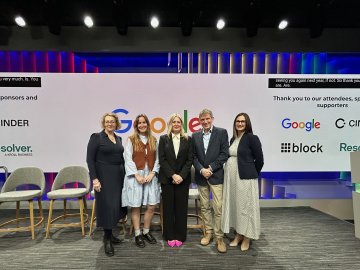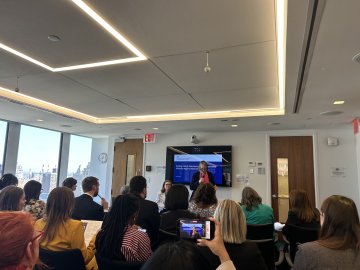
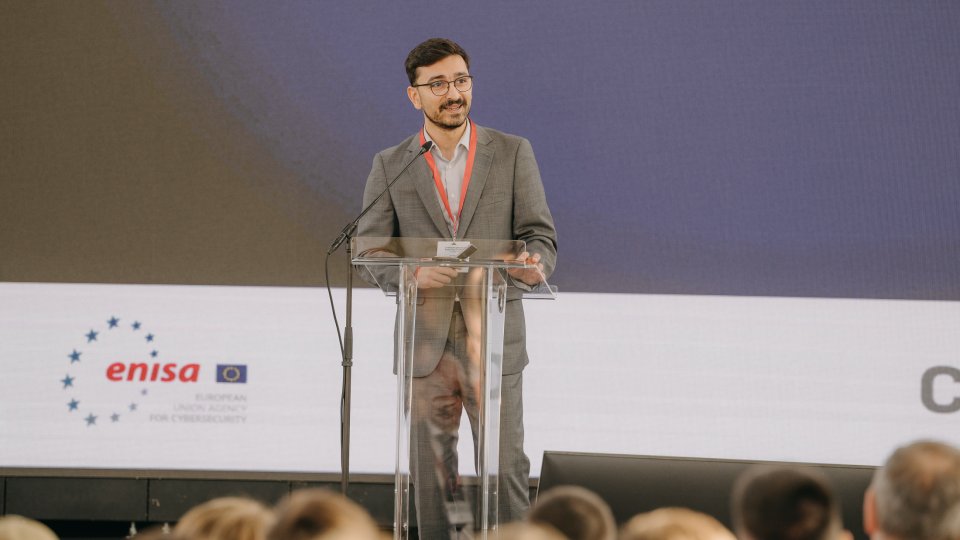
Last week, SWGfL stood at the centre of two very different but deeply connected conversations happening in Europe. Across the week, we moved from the chambers of the European Parliament, addressing lawmakers on the urgent realities of technology-facilitated gender-based violence, to the stage of ENISA’s Cybersecurity Awareness Conference, where we delivered a keynote on building human-centred, AI-powered security solutions. Both events, although different, allowed us to further our call for the same message: Technology is evolving faster than protections, and we cannot meet tomorrow’s threats with yesterday’s tools.
European Parliament
At the event on Gender-Based Violence hosted in the European Parliament, SWGfL presented a stark reality: Intimate image abuse is escalating at a pace that outstrips global preparedness.
Standing before Members of Parliament, Commissioners, policymakers, and civil society leaders, Boris Radanovic shared ten years of insight from our own Revenge Porn Helpline, a decade marked by an alarming surge in victims seeking help. We presented the current landscape:
- 521 cases in 2015
- 3,146 cases in 2020
- 22,275 cases in 2024
- More than 60,000 people supported to date
- Over 400,000 non-consensual intimate images removed
We highlighted the gendered disparity in victimisation, women being disproportionately targeted and harmed, and the urgent need for accessible, confidential, and non-judgemental reporting pathways.
We also made a clear call for the adoption of StopNCII.org, the world-leading, privacy-preserving tool created to prevent the non-consensual sharing of intimate images. Already used by major global platforms, its impact depends on adoption at scale, especially as Europe rolls out the Digital Services Act (DSA) and the Violence Against Women Directive. Our message emphasised that Europe has the most ambitious legal framework in the world and it’s time to give victims the infrastructure they deserve.
Cybersecurity at ENISA
At ENISA’s Cybersecurity Awareness Raising Conference in Athens, the conversation shifted, from legislation to behaviour. From policymakers to 300 cybersecurity professionals gathered to explore the human side of digital risk. Our keynote, “Awareness in the Age of AI,” explored one central idea - Awareness programmes must evolve from compliance to action.
To bring this to life, Boris introduced the story of Grace, a fictional employee designed with the help of AI, used by organisations to craft emotionally resonant, story-driven cybersecurity learning.
Grace is relatable, flawed, curious, and human. She receives phishing emails, she makes mistakes and she almost falls for scams. And because employees see themselves in her, they learn without being lectured. This was just one of the stories used to present how AI can be used for championing good practice and behaviour.
We shared with the ENISA audience how organisations are using AI to:
- Analyse behavioural patterns
- Personalise awareness messages
- Create better user journeys
- Rewrite harsh error messages into helpful guidance
- Run “Reverse Turing Drills” to train deepfake detection
- Scale psychological insight ethically
And crucially, to do all of this while maintaining our own touch i.e. human oversight, human review, and transparency when AI is used.
Safety Needs Systems and Innovative Solutions
European Parliament reminded us that victims need systems, legal protections, reporting pathways and cross-border tools like StopNCII.org whilst ENISA reminded us that technology can be used to inform and educate through solutions that turn abstract risks into something they can fully appreciate and relate to.
SWGfL will continue:
- Working with EU institutions on the implementation of the Violence Against Women Directive
- Supporting Digital Services Coordinators in embedding StopNCII.org
Sharing research and best practice in NCII prevention. - Helping organisations fully realise the potential for AI solutions around cybersecurity
We look forward to attending more events and sharing our guidance and expertise around how we can ensure everyone can benefit from technology free from harm.